

Parliament
CEMAC Parliament Closes First Ordinary Session of 2026, Emphasizes Unity, Integration, and Transformation

Njila Boris
March 2026
2 min read
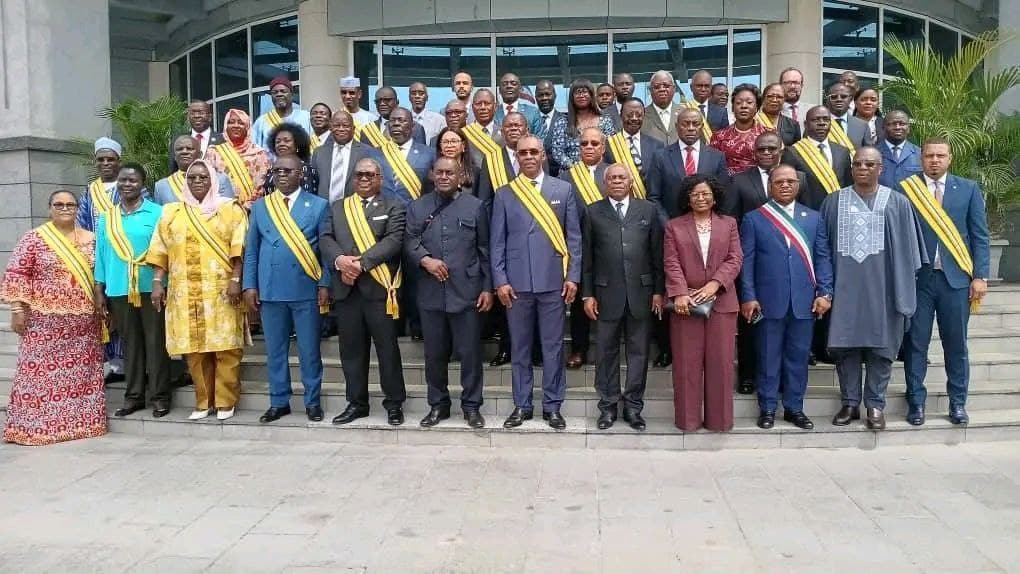
The Economic and Monetary Community of Central Africa (CEMAC) Parliament officially concluded its first ordinary session of the year 2026 on 3 March, with Vice-President Hon. Alexandre Gilbert Awassi delivering the closing address on behalf of the President of the Parliament, Hon. Fernand Sabaye, who was unable to attend. The session, held in Malabo, brought together high-level authorities from the host country, members of the CEMAC Commission, diplomats, and representatives of international organizations accredited to Equatorial Guinea. Hon. Awassi opened his remarks by acknowledging the broader context in which the Community operates, highlighting ongoing global humanitarian crises and extending solidarity to affected populations, including nationals of CEMAC member states. He stressed that the Parliament remains conscious of its role not only as a legislative body but as a voice of cohesion, justice, and development for the region.
The 2026 session was marked by the presentation and adoption of the 2025 Annual Report on the functioning and evolution of the Community. The report, examined thoroughly by the Commission on Institutional Affairs, Justice, Human Rights, and Common Sectoral Policies, provides a comprehensive assessment of CEMAC’s socio-economic and institutional landscape over the past year. Several challenges were highlighted during the discussions, including financial constraints stemming from non-remittance of the Community Integration Tax (TCI) by member states, which hampers institutional operations. Only Gabon among the six member states has fully implemented mechanisms for collection and remittance. Fragile foreign reserves linked to import dependence, rising debt service, and declining international budgetary support were also cited. In addition, structural and economic adaptation issues were discussed, including limited industrial transformation of raw materials and incomplete repatriation of funds dedicated to community restoration projects. Other concerns included barriers to free movement, due to multiple checkpoints and the absence of joint monitoring brigades along regional corridors, and the challenges of statelessness, which affect the integration and identification of CEMAC citizens across member states. Hon. Awassi urged members to recognize that stagnation threatens the relevance of the Community and cited African and French proverbs to reinforce the need for collective action: “If you want to go fast, go alone. If you want to go far, go together,” and “Still waters run deep,” emphasizing that transparency and collaboration are essential for progress.
The Vice-President called for a paradigm shift in CEMAC’s approach, stressing that the transformation of raw materials into finished products is key to economic sovereignty and sustainable regional development. He underscored that industrialization, from agriculture to energy and manufacturing, is central to unlocking the region’s full potential. On procedural matters, the Parliament issued clear recommendations and a resolution to the CEMAC Commission. These included ensuring timely submission of the Annual Report on CEMAC’s functioning and evolution to Parliament before 10 September each year, for discussion in the second ordinary session. The Parliament also recommended conducting awareness campaigns to educate citizens on free movement of people and goods and encouraged the display of the CEMAC flag alongside national flags in all public spaces to enhance the Community’s visibility. Furthermore, the Parliament enjoined the Commission to fully implement the decisions of the Council of Ministers of the Central African Economic and Monetary Union (CEMAC) of 9 September 2025, with a detailed progress report due by 31 March 2026.
Hon. Awassi acknowledged the upcoming national and international events, including the presidential election in the Republic of Congo and the International Women’s Day on 8 March 2026, emphasizing that the Community stands in support of peace, justice, and empowerment for all citizens, particularly women and girls. He highlighted that the session provided a forum not only for evaluating institutional performance but also for issuing a call to action to address the persistent socio-economic and governance challenges faced by the Community. In conclusion, he extended gratitude to the diplomatic corps, the CEMAC Commission, the host country of Equatorial Guinea, and all parliamentary staff for their dedication, highlighting that the success of the session demonstrates the Community’s potential when unity, professionalism, and cooperation are prioritized. The session formally closed with calls for continued advocacy, collaborative engagement, and transformative action across the region, reaffirming CEMAC’s commitment to integration, socio-economic development, and regional solidarity. Long live the CEMAC Parliament! Long live regional integration!