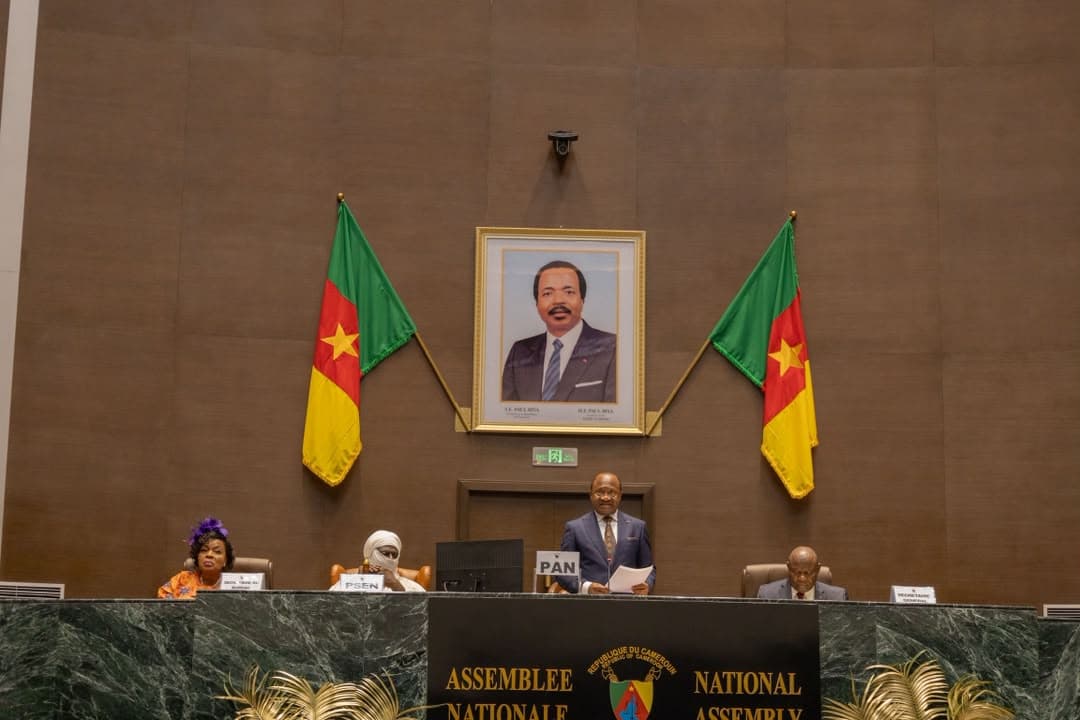
Speaker, Hon Datouo Opens June Session With a Call for Transparency, Reform and National Renewal
By Ebika Mofor · 6/30/2026
The Paul Biya Glass House in Ngoa-Ekelle, Yaoundé, was the setting on June 9, 2026, for the solemn opening of the Second Ordinary Session of the National Assembly for the 2026 Legislative Year, as the Right Honourable Théodore Datouo, President of the National Assembly, delivered an opening address that was at once a tribute to the fallen, a reflection on a nation at a pivotal moment, and a clear-eyed statement of the legislative priorities that will define the weeks ahead.
The session opened in the shadow of profound institutional loss. The Right Honourable Datouo did not shy away from the weight of the moment, opening his address with words of mourning for what he described as two patriarchs of Cameroon's Parliament. The President Emeritus of the Senate, Senator Marcel Niat Njifenji, died in Yaoundé on April 11, 2026, taking with him a legacy of uncommon wisdom and decades of distinguished public service. As a well-known engineer, accomplished statesman, and pioneer President of the Senate from its inception in 2013, he had led the chamber with the rigour and intelligence that defined a long and extraordinary career. A few weeks later, the nation learned with consternation of the death of the Emeritus Speaker of the National Assembly, the Right Honourable Cavayé Yéguié Djibril, a man whose political legacy, in the Speaker's own words, virtually conflates Cameroon's contemporary history. A traditional ruler, an elected representative with popular grassroots support, a staunch militant of the Cameroon People's Democratic Movement, and Africa's longest-serving parliamentarian before his death, Cavayé Yéguié Djibril had served as Member of Parliament for more than half a century and as Speaker for thirty-four uninterrupted years with authority, experience, and statesmanship. The Speaker added that the cold hands of death had also taken the Honourable Mbe Assae Théodore Alexandre, Member of Parliament for the Dja and Lobo Constituency, who was serving his fourth mandate and chairing the Committee on Economic Affairs with competence and dedication. The assembly rose in a solemn minute of silence in memory of all departed parliamentarians, observed in the presence of the President of the Senate, the Prime Minister and Head of Government, the President of the Constitutional Council, the Chief Justice of the Supreme Court, the Attorney General of the Supreme Court, members of government, ambassadors, and representatives of international organisations.
The Speaker then turned to the national and international landscape within which this session is opening, describing it as a period marked by landmark events of global importance. He began with the Fourteenth Ministerial Conference of the World Trade Organisation, which took place in Cameroon, in which he personally participated alongside government officials, private sector representatives, and delegations from across the world. He described the conference as an important step in the collective quest to make the World Trade Organisation more effective, credible, and sustainable, and commended the full participation of public authorities and the organisational quality that allowed Cameroon to once again demonstrate its diplomatic savvy and its capacity to host international events of the highest order. He saluted in particular the inputs of the Government of Cameroon under the stewardship of the Prime Minister, Head of Government, who served as the personal representative of the President of the Republic, His Excellency Paul Biya.
A second landmark was the apostolic visit of His Holiness Pope Leo XIV, a moment the Speaker described as of exceptionally spiritual and human importance. He noted that Cameroonians, notwithstanding their political, socio-cultural, and religious diversity, massively turned out to welcome the Pope with enthusiasm and joy. The Pope's message in Yaoundé, Bamenda, and Douala was one of dialogue, social justice, reconciliation, resilience, and peace. The Speaker drew particular attention to the scenes in Bamenda, where thousands of people came to listen to the Pope's message of forgiveness and reconciliation in a region that has been deeply affected by years of armed conflict, describing the massive turnout in Bamenda as one of the most powerful and enduring images of the papal visit. Shortly thereafter, Cameroonians celebrated the 54th anniversary of National Unity Day with enthusiasm, reaffirming their loyalty to the Fatherland, republican institutions, and the ideals of living together. The Speaker identified unity as the central theme running through all these events, noting that it was unity that enabled Cameroon to organise the World Trade Organisation Ministerial Conference with resounding success, unity that enabled Cameroonians to give the Pope a historic welcome, and unity that enabled the country to celebrate its shared destiny on May 20. He called on Members of Parliament, wherever they are and wherever they speak in the name of the Republic, to prioritise three things above all: the maintenance of peace, the consolidation of national unity, and the duty to bequeath to succeeding generations the legacy of peace and unity. "Development is impossible without peace," he declared. "There is no nation without unity. There is no future without social cohesion."
Looking ahead on the international parliamentary calendar, the Speaker announced that Cameroon will shortly play host to the 51st General Assembly of the Parliamentary Assembly of La Francophonie, the organisation that brings together parliaments of states and governments that have the French language as their common denominator and that serves as a platform for dialogue, cooperation, solidarity, and the promotion of democratic values in French-speaking countries. The General Assembly, which will be held under the distinguished patronage of the President of the Republic, His Excellency Paul Biya, will bring together hundreds of parliamentarians from five continents. On the sidelines of the Assembly, events will include proceedings of the Francophone Youth Parliament, meetings of the Network of Women Parliamentarians, meetings of Youth Parliamentarians, Standing Committee meetings, and those of the steering organs of the Parliamentary Assembly of La Francophonie. The Speaker urged the Organising Committee to rigorously prepare and make the General Assembly a success story and a conducive setting for fruitful discussions on the major challenges facing Francophone countries, expressing the collective aspiration that Yaoundé would become one of the world's capitals of parliamentary dialogue, peace, and cooperation.
The substantive legislative agenda of the June session was laid out with clarity and candour. The Speaker identified two pressing issues drawn from the daily concerns of Cameroonian citizens as the priority focus of this session. The first is the mining sector. Acknowledging that Cameroon's subsoil is potentially rich in mineral resources that should act as a catalyst for economic development, job creation, infrastructure development, and the structural transformation of the economy, he noted with concern that public debate is increasingly rife with questions about the revenue currently generated by the exploitation of certain resources, and that answers remain elusive. He raised the issue of mechanisms for collecting, managing, and redistributing revenue thus generated, and noted that people in mining areas sometimes feel that the wealth extracted from the subsoil is not genuinely improving their living conditions, a situation that fuels a sense of misunderstanding. He called on sector ministries and government officials to redouble efforts to improve transparency, oversight effectiveness, revenue traceability, and the fair redistribution of economic benefits to local populations, and affirmed that Parliament must continue to fulfil its task of legislating and exercising government oversight. "The time has surely come to brainstorm on the reforms needed to enable our country to derive greater benefits from its mining resources, while ensuring that the interests of the communities concerned are more effectively taken into account," he declared.
The second issue addressed by the Speaker was land tenure, which he described as a domain where recurring disputes, protracted litigation procedures, competing claims, and reprehensible practices have created the impression that legally established procedures may be called into question. He acknowledged that public authorities have already taken initiatives aimed at modernising land governance, and called for these initiatives to be sustained. His message to the legislature was unambiguous: Cameroonians do not expect sterile debates. They expect solutions and meaningful reforms. They expect institutions to work together in the service of the common good.
The Speaker concluded by focusing attention on what he described as one of the high points of the session, the Budget Policy Debate, the exercise through which Parliament lays the groundwork for the budgeting choices of the year ahead. He described it not as a technical exercise but as a special moment of dialogue between the government and the nation's representatives, a moment that affords Members of Parliament the opportunity to voice the concerns of their constituents, encourages anticipation, enhances the quality of public decision-making, strengthens transparency, and enables public policies to better reflect the real expectations of the people. "The deliberations we shall hold in this Chamber will help in shaping the State Budget for the year 2027," he said, calling on Members of Parliament to conduct deliberations in a spirit of responsibility, rigour, and constant pursuit of the general interest. "Parliament is not merely the place where laws are passed," he reminded the assembly. "It must be the place where the concerns of the people find an echo and are properly addressed."
On that note, the Right Honourable Théodore Datouo declared open the proceedings of the Second Ordinary Session of the National Assembly for the 2026 Legislative Year